AI isn't slowing down your deliveries. Your organization is
When AI multiplies your output by 17 but your deliveries only grow 30%, the problem isn't the tool, it's how your delivery chain is organized.

The numbers are now documented.
A study of more than 100,000 GitHub developers, conducted over four years, confirms what many suspected but couldn't quantify: with the latest generation of AI agents, the volume of code produced multiplies by 17. The releases delivered, on the other hand, only rise by 30%.
In between: an organization that hasn't moved.
The wrong diagnosis is costly
Many companies today measure their AI transformation with the wrong indicators. Commits explode, stories close faster, velocity hits record highs. And the conclusion is that it's working. But what's being measured is code production, not value delivery.
The software chain is sequential: the code produced must be reviewed, merged, validated and deployed. AI has radically accelerated the first stage. It hasn't touched the ones that follow. The result: pull requests pile up, tech leads get overwhelmed, and go-live decisions become increasingly scarce. Output throughput stays constrained by the same human bottlenecks as before. Only now, the upstream pressure has become three to ten times greater.
This phenomenon has a name in the economic literature: a low elasticity of substitution between AI output and human effort. In operational terms, it means that AI and people are not interchangeable within the chain: they are complementary. And it is the human element that constitutes the limiting link.
The siloed organization reveals its fragility
The most common, and most fragile, case is that of the lead developer who is the only person authorized to merge and to trigger go-lives. Before AI, this model worked: the volume of code produced was compatible with the capacity of a single control point. An absence created discomfort. Two simultaneous emergencies created a traffic jam.
With asynchronous agents, this model collapses. That same lead developer faces a flow of pull requests they cannot absorb without degrading either the quality of their review or their availability for the architecture decisions that are truly at their level.
It's not a tooling problem. It's a bus factor problem: a single person whose absence or saturation blocks the entire team's delivery.
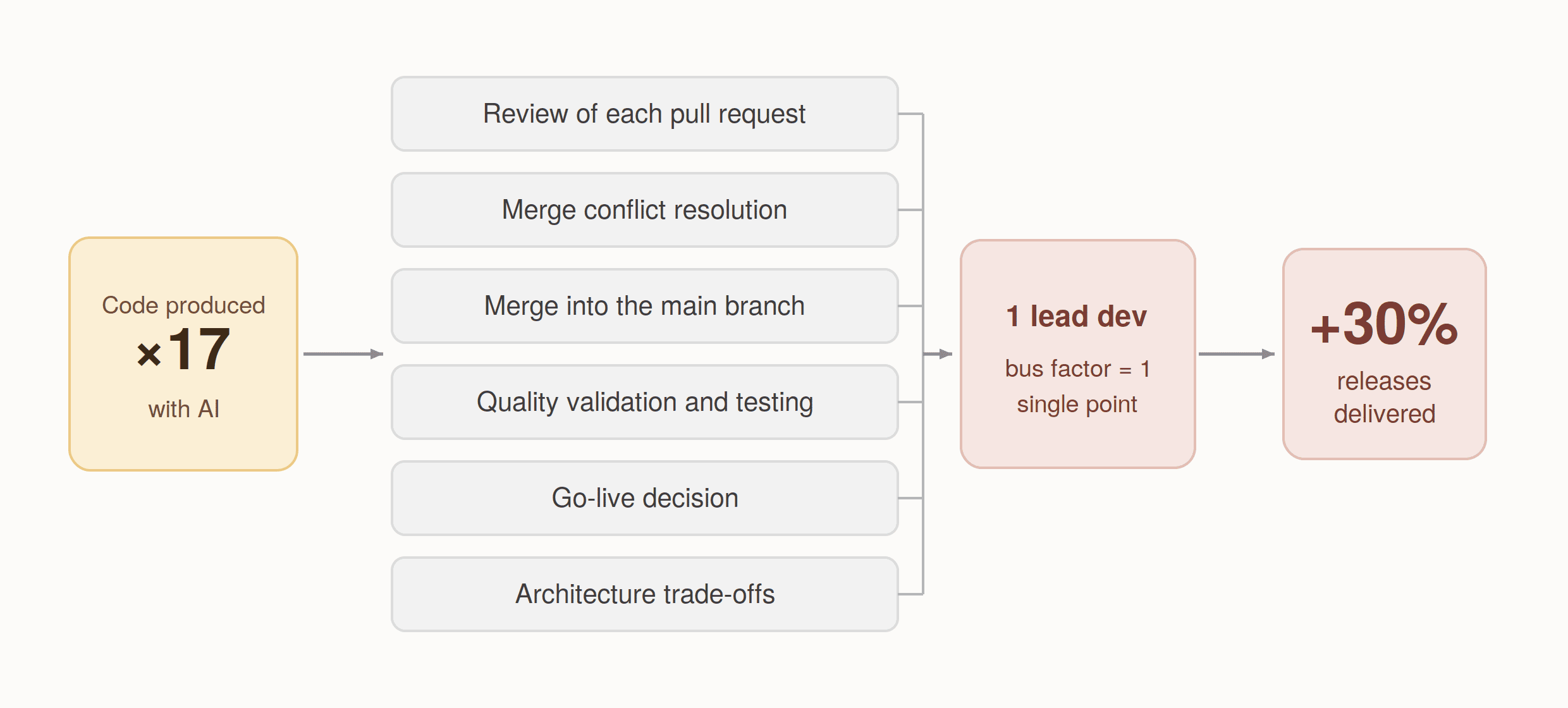 AI multiplies code by 17. These tasks remain manual and converge on a single person. Result: only +30% of releases at the output.
What the data also says about quality
The same study extends its analysis to the app stores. Since mid-2025, the number of new apps published has surged. Total usage, however, has remained stable. The share of apps that fail to reach a minimum audience has increased across every market.
Producing more does not mean delivering more perceived value. That breaking correlation between volume produced and real adoption is a signal that tech decision-makers should take seriously well beyond the app stores: in their own backlogs, in their own sprints, in what their teams ship to users whose attention, unlike output, has not multiplied tenfold.
The real question is not “which AI tool?”
The public debate about AI in software development remains largely captured by the question of tools: which agent to choose, which model, which IDE integration. It's the wrong question — or at least, it's not the main one.
The main question is organizational: how is the delivery chain structured to absorb a production volume that can multiply by an order of magnitude? Who can merge? Who decides to deliver, and how often? How is product knowledge distributed across the team so that prioritization trade-offs are fast and sound? What process makes it possible to adjust scope without blocking the client relationship?
These questions are not new. What's new is their urgency. Organizations that had twenty years to address them now have eighteen months.
What changes for decision-makers
AI doesn't replace the organization: it X-rays it, it lays it bare. Structural fragilities that were manageable under a human-production regime become breaking points under an augmented-production regime.
The CIOs and CTOs who will get the most out of this transition are not necessarily those who have adopted the most powerful agents. They are the ones who will have managed, in parallel, to redistribute critical delivery capabilities, recalibrate their management indicators, and engage their clients in a governance of change adapted to the new pace.
AI produces fast. Value, on the other hand, is still created across the entire chain.
At Infinitum Digital, together with the Clever Age group, we see it every day: AI doesn't create the bottlenecks, it reveals them. There's little point in multiplying code if delivery still depends on a single point of decision.
We help you redesign that chain: redistribute critical delivery capabilities, recalibrate your indicators, and govern change at the new pace. Technology produces fast; value is created by your organization. Shall we talk?