GEO and product images: why AI may recommend your product… with the wrong photo
When we talk about GEO (Generative Engine Optimization), we usually think about text: how to get ChatGPT, Gemini or Perplexity to cite our pages. But generative answers are increasingly visual.

Google AI Mode shows product carousels, ChatGPT embeds images, and e-commerce product pages now compete within the answer itself. Which image does AI choose to show your product? And why does it sometimes choose the wrong one?
That was the underlying question of the “GEO & Assets” webinar, which we held within the Clever Age group together with Scaleflex and Easy Cash.
The most valuable part was that we didn't stop at theory: we audited Easy Cash's real catalog in Google AI Mode and in ChatGPT. These are the ideas we took away.
Generative search is no longer an experiment
The starting point is clear: the shift from a list of links to a direct answer is consolidated. The webinar distinguished three families of tools. Conversational agents, such as ChatGPT or Claude, hold a dialogue and answer based on what they already know, and do not always cite sources. Hybrid search tools, such as Perplexity, search in real time and always cite. And traditional search engines, led by Google, add generative AI blocks above or alongside the classic results.
How AI chooses what to show
To optimize, you need to understand the mechanism. Simplifying what was explained in the webinar:
- Google (AI Overviews and AI Mode) breaks the query down into sub-queries (query fan-out), selects the most relevant documents from its index and builds the answer anchored in those documents (grounding).
- ChatGPT starts from a probabilistic model trained on its own knowledge base, drawn from its crawling, Common Crawl and other sources. Only when it needs to does it run searches to check it against recent information.
In both cases, if the content, including images, is not accessible at the moment the robot looks for it, it simply does not exist for the answer.
First, make sure nothing blocks your images
Many e-commerce sites serve their images from a CDN separate from the website. This means checking accessibility in both places, and there are several common blocks:
- Anti-hotlink protections or signed URLs, designed to save bandwidth.
- JavaScript lazy-load, which some robots do not execute.
- robots.txt rules that exclude AI bots.
The important nuance is that engines do not retrieve the image in the same way. ChatGPT loads it live when displaying the answer, so a block breaks it instantly and leaves no trace on your website. Google crawls it and caches it: even if you block it, it may keep showing a thumbnail generated during the crawl, and the result degrades without you noticing. It is also worth knowing that OpenAI's robots do not behave the same way: OAI-SearchBot respects robots.txt, whereas ChatGPT-User may ignore it.
In addition, Google's own documentation indicates that the Merchant Center feed carries more weight than the website for appearing in AI answers. The quality of the catalog, its approval and its freshness matter more than the alt text.
The Easy Cash case: three searches, three lessons
Easy Cash buys and sells second-hand products through some 165 stores, most of them franchised, and through its website. It has more than one million items listed, and each one corresponds to a physical unit in a specific store. The catalog goes “from manga to Rolex”: smartphones and gaming with official manufacturer images sit alongside luxury bags and jewelry, unique pieces that store staff photograph by hand.
The team audited ten products (luxury bags, iPhones and video games) and tested eight robots: GPTBot, OAI-SearchBot, PerplexityBot, ClaudeBot, Googlebot, Bingbot and those of Facebook and X. Nothing was blocked. So the room for improvement lay in the visual assets themselves.
Below, we show some search examples with the results and the proposed improvement countermeasures.
- “Second-hand Mario Kart”
Google AI Mode showed a carousel with Easy Cash against a competitor. Easy Cash's image, clean and professional, visually outshines the competitor's amateur photo. In addition, the answer included trust arguments taken from Easy Cash's website. In second-hand, a carefully taken photo conveys a better product condition and removes a barrier to purchase.
- “Second-hand iPhone 17”
Easy Cash took 15 of the 17 images in the answer: 1024 × 1024 pixels, white background, product well framed. Technically, perfect. The problem is that they were Apple's official visuals, the same file used by Rakuten or Fnac, so no differentiation was possible. Scaleflex's proposal is to enrich what accompanies the image: a descriptive file name (for example, iphone-15-pro-titanio-natural-128-go-easycash.jpg), a consistent slug in the CDN URL and a unique, bilingual alt text that clarifies what is shown, what condition it is in and who is selling it.
- “Second-hand Yves Saint Laurent 5 to 7 bag Easy Cash”
This is where the serious problem appeared. Google even gave a price range, but of the ten images it showed, only two corresponded to the bag searched for. There were wrong models from the same brand, Louis Vuitton bags, the Easy Cash logo and photos from a competitor and from Leboncoin.
The diagnosis: AI Mode cited the category page first and the product page came third. The image chosen was the first product in the category grid at the time of the crawl, and that grid changes with stock. In addition, the product page did not always “declare itself” as a product to a robot that does not execute JavaScript: part of the markup loaded asynchronously and the URL disappeared when the item was sold. This is a typical risk for catalogs of unique items.
There was a second factor: the bags were published as PNG with a transparent background (between 36% and 68% transparent pixels). On a white background they look flawless, but a transparent PNG takes on the background of the interface that displays it. Google explicitly advises against transparent backgrounds in Merchant Center. It asks for a white or plain background, the product taking up between 75% and 90% of the frame, and a recommended 1500 × 1500 pixels. The 2024 Google Content Warehouse leak also revealed an attribute, whiteBackgroundScore, which estimates whether an object appears isolated on a clean white background: a signal of a professional product photo versus an amateur snapshot.
“Why enrich images if AI already understands them?”
It was one of the audience's questions, and the answer has two parts. The first is cost: if the file name and alt text say nothing, the engine has to open and analyze the image, which costs it crawl time and computing power that it will not always want to spend. The second is control: if you let a bot crop, describe or correct your image, it may conclude that a white bag is beige because of poor white balance, or call a model by a name that is not yours. As Laura Berger summed it up, AI does a good job, but it is not magic, and it will never be as precise as a brand that controls its taxonomy and its vocabulary.
That is why Scaleflex insists on a well-ordered image value chain: quality control (resolution, lighting, inappropriate content, rights), metadata enrichment, optimization and delivery via CDN. The order matters. Cropping an image that has already been over-compressed, for example, gives a pixelated result that is then costly to fix. And a controlled, bilingual vocabulary is advisable: models are trained mostly on English-language content and, according to what has been observed in logs, they often consult the English version of a website first.
What about video?
It follows the same logic, with more text: title, description and, if the title is not enough, a longer summary with chapters. Also transcription and translation. As for where to host it, the recommendation was clear: YouTube is an authoritative source, but if the videos explain specific products, it is advisable to index them under your own domain too. That way the model associates them unambiguously with your brand, your catalog and your product page.
Five tips to improve your visual GEO
- Ensure fast access to the file: lightweight, in a modern format and served via CDN, for both people and robots.
- Maintain brand consistency across all channels: the same image for the same product on the website, social media and partners, and never the same image for two different uses.
- Make the name and alt text explain the image: “nike-air-max-270-black-men.jpg” instead of “IMG_4588.jpg”.
- Provide structured data: category, brand, use case and audience, everything that helps relate the image to its context.
- Reuse images with intent: an image that appears on the product page, the FAQ, the blog or in the press is understood better than one that lives in isolation.
How long it takes to make a difference
Not everything moves at the same pace. What the engine reads on demand changes quickly. What it keeps in reserve changes slowly, and the image is the slowest layer. These were the indicative timeframes shared by Clever Age:
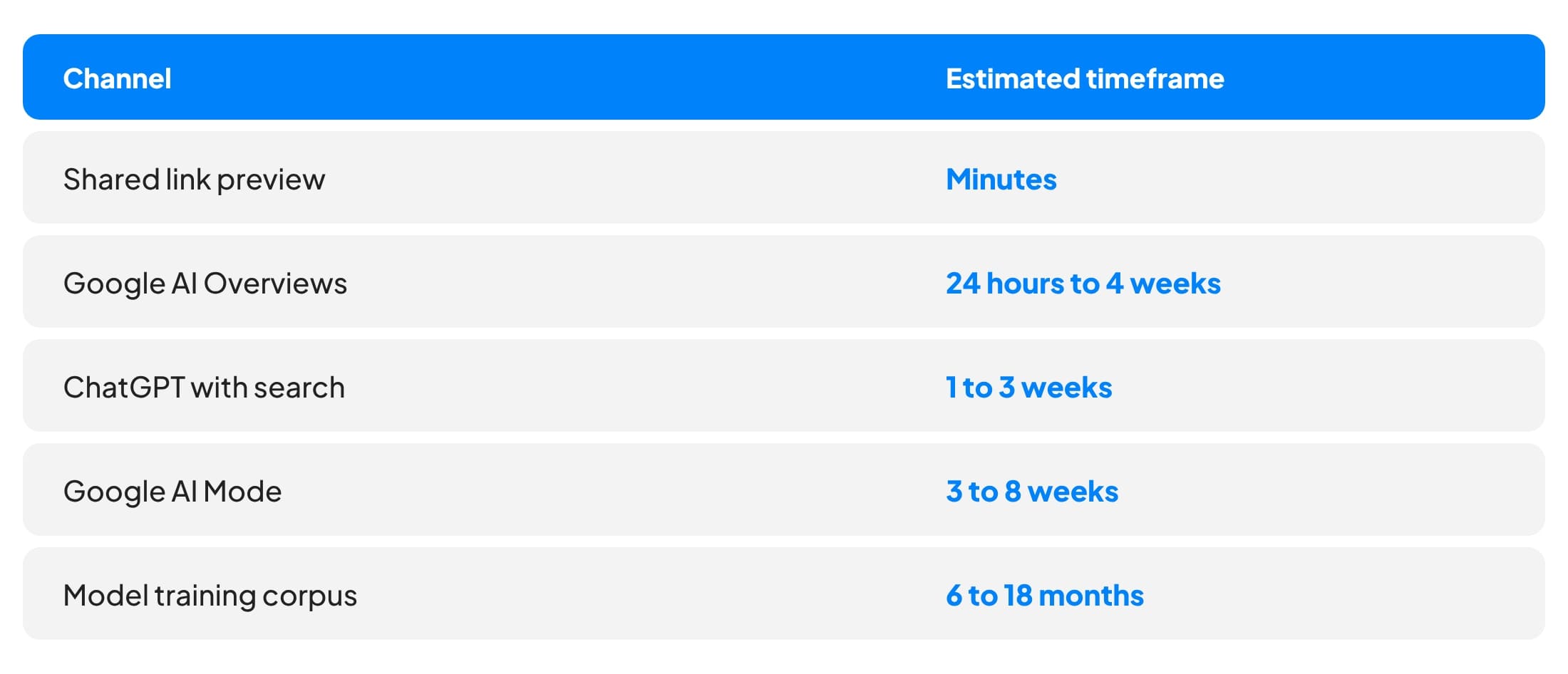 There are two pieces of good news. Changing robots.txt to allow or block a bot takes effect within hours, because Google rereads the file in under 24 hours. And ChatGPT adds utm_source=chatgpt.com to its outbound links, so that traffic can already be measured in analytics without additional development. Regarding the increase in bot traffic that many brands see in their logs and on their CDN, the advice was not to block it by reflex, but to analyze it calmly: it can be a very positive signal in the medium term.
Our conclusion
The webinar leaves us with an idea we share: in generative search, the image is no longer decoration, it is information. It can decide which product AI recommends and, in Easy Cash's case, whether it recommends the right product. What we have known for years about image SEO (descriptive names, alt text, clean background, performance, structured data) is still the foundation. What changes is the cost of not doing it: before, it meant losing a position in Google Images; now it means an assistant showing your customer the wrong bag.
Our recommendation is to start with a simple diagnosis: check whether AI robots can access your images, run a dozen real searches for your key products in AI Mode and in ChatGPT, and see which images appear and where they come from. The results are often surprising.
Want to know what AI sees when it searches for your products? At Infinitum Digital we help you audit your visibility in generative search and prioritize the improvements with the greatest impact. Let's talk.