GEO: The new frontier of digital visibility
How to optimize your digital presence to be cited in ChatGPT, Gemini, Claude and Perplexity before your competition.

From winning the click to being the chosen answer: the new paradigm.
For more than two decades, digital visibility in search engines followed a stable logic: appearing in the top results on Google meant visibility, traffic and business. That paradigm has been structurally broken.
Have you noticed that your organic traffic is falling, even though you keep investing in SEO? That your clients arrive with answers already formed, as if they had previously consulted an expert? That your competitors appear on screens where you are absent, without you knowing exactly why?
In 2026, generative search engines (ChatGPT, Gemini, Perplexity, Claude…) have redefined the way millions of people access information, compare options and make purchasing decisions. We are not talking about an emerging trend: it is a change already consolidated in digital behavior, with a direct and measurable impact on organic traffic, lead acquisition and the brand reputation of organizations across all sectors.
In this context, GEO (Generative Engine Optimization) emerges as the strategic discipline that determines whether a brand is, or is not, cited, recommended and used as a reference source by Large Language Models (LLMs). And, contrary to what might seem, it does not replace SEO: it expands it and makes it more demanding.
What is GEO and how does it differ from SEO?
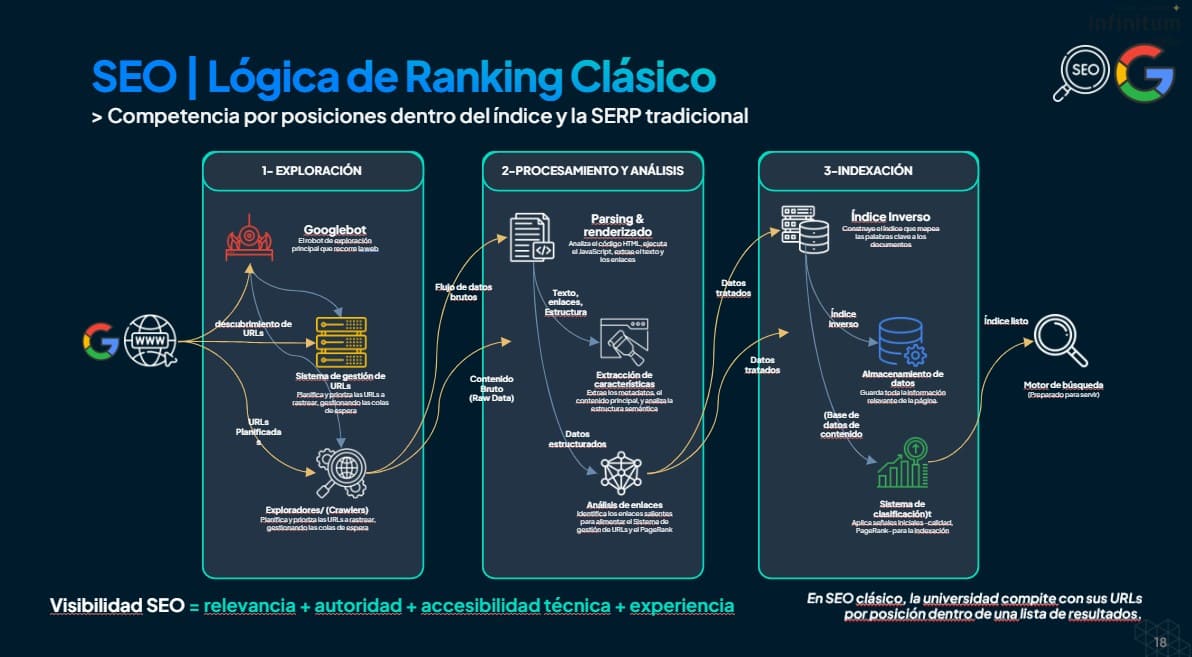
The most common strategic mistake is to frame GEO as an alternative to SEO. The operational reality in 2026 is more nuanced: Google remains the dominant platform with 88.5 billion visits per month and AI engines rely heavily on their own index to build responses. A technically sound SEO is a necessary condition, although no longer sufficient, to exist in the current digital ecosystem.
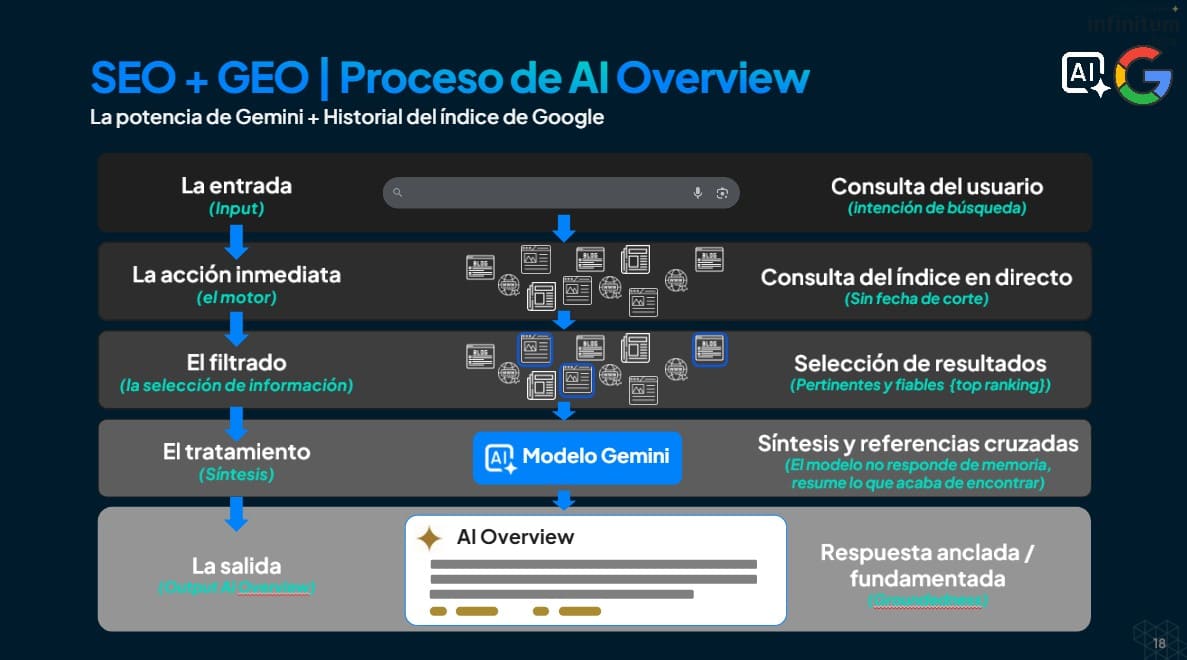
While SEO competes for position within a list of results to win the user's click, GEO works so that the brand is the source that AI cites directly in its response. Relevance signals are also different: SEO relies on keywords, backlinks and Core Web Vitals; GEO requires E‑E‑A‑T, structured data and content with high citability. Metrics evolve accordingly: from CTR and average position toward mentions, citations and AI Share of Voice.
The intelligent visibility strategy in 2026 operates on two simultaneous objectives: appearing at the top of Google and becoming the AI’s reference citation. They are complementary channels — 95% of ChatGPT users also use Google, whose simultaneous coverage multiplies the visibility surface without cannibalizing audiences.
The 5 pillars of an effective GEO strategy
Optimization for generative engines is not a one-off adjustment or an isolated tactic. It is a methodology structured around five interdependent areas of work that, implemented in an integrated way, determine an organization’s ability to appear consistently in LLM responses.
1. Technical accessibility: opening the right doors to AI bots
The main AI engines use specialized bots to crawl the web and build their knowledge bases. If your site blocks or hinders access to these agents, your content will not exist in their responses, regardless of its quality. The strategic decision is not binary, open everything or block everything, but rather requires a well-calibrated selective access policy.
2. Thematic territory mapping: where you want to be the reference
GEO is not a total coverage approach. The most effective strategy requires identifying a limited number of thematic territories (maximum three or four) in which the organization has both the capacity to generate authoritative content and the commercial interest to do so, and concentrating all resources on becoming the LLMs’ reference source in those specific spaces.
Prompt Research, the process of identifying and analyzing how the audience actually formulates its queries to AI, is the central analytical tool of this phase. Unlike classic keyword research, prompt research captures intent in conversational format and covers the entire decision funnel: from discovery questions to comparison and conversion questions. Topic selection must cross two variables: the profitability of the program or service and current AI visibility. It is advisable to prioritize where there is already some level of presence and where the return is greatest.
3. E‑E‑A‑T authority: AI only cites what it considers reliable
Large language models do not recommend sources at random: they actively evaluate the credibility of organizations before including them in their responses. The E‑E‑A‑T framework (Experience, Expertise, Authoritativeness, Trustworthiness) defines the four dimensions of that evaluation. Without these four consolidated pillars, AI will not consider your organization a safe reference source.
- Experience: real data, success cases, verifiable metrics.
- Expertise: author profiles with credentials, thought leadership.
- Authority: presence on Wikipedia, Knowledge Graph, sector publications.
- Trustworthiness: accreditations, methodological transparency, traceability.
4. AI Ready structuring: speaking the language of machines
Structured data under the Schema.org standard is the “native language” that allows AI to unambiguously understand what your organization is, what it offers and why it is relevant for a specific query. The difference is radical: a text that says “the company offers digital consultancy with more than ten years of experience and prices according to scope” forces AI to guess what a service is, what a price is and what the specialty is; the same content marked up with Schema.org (Organization, Service, Offer, foundingDate) allows AI to extract each piece of data instantly, without ambiguity or risk of incorrect interpretation.
5. Content optimized for citation: quality and structure over volume
The type of content that LLMs favor for citation has specific characteristics that differ substantially from content optimized solely for traditional SEO. The models look for fragments that answer a question in a complete, autonomous and verifiable way, directly extractable and citable in the response without requiring additional interpretation.
The Semantic Chunking technique, structuring content in independent thematic blocks, each centered on a single idea and headed by an H2 that functions as a direct answer to a specific question, is the most effective mechanism for increasing the probability of citation. A dense paragraph that addresses five different aspects in 400 words is significantly less citable than five blocks of 80 words, each answering a specific question with precision. AI knows exactly which fragment to extract when the content is well divided; faced with dense blocks, it has to guess.
The new KPIs: measuring visibility in the AI era
An effective GEO strategy requires its own metrics system that goes beyond organic traffic and Google positions. The key performance indicators for visibility in LLMs are structured around four dimensions.
- Mentions and citations in AI: Measure the frequency with which the brand appears in responses from ChatGPT, Gemini or AI Overviews, distinguishing between mention (reference in the body text) and citation (explicit link to a page).
- AI Share of Voice: Out of every ten responses about your category or topic, how many include your brand? It is the metric that measures who dominates the conversation in each thematic territory. With nearly 90% share of voice in some sector analyses, this indicator can reveal very clear dominances against the competition.
- Sentiment score: Measures the emotional tone associated with the brand in generative responses, fed primarily by reviews on Google Maps and discussions on Reddit and specialized forums, the sources from which AI “learns” what people think of an organization.
- Traffic and leads coming from AI: Measures the real business impact: sessions and conversions attributable to references from AI platforms, integrable into GA4 dashboards through source segments and UTMs.
The window of opportunity is open now
when a potential client asks what the best provider in their category is, which service to choose, which brand to trust. Organizations that understand and act on this reality today are building a competitive advantage that, as generative engines gain weight in the decision process, will be progressively more difficult to reverse.
GEO does not replace SEO: it elevates it. Brands that already have a solid base of organic authority are in an advantageous position to build visibility in LLMs. And those that do not have it now have the opportunity to build both simultaneously, with a clear methodology and measurable results.
The early mover window in GEO is still open. But it is closing.
Key messages:
- If you don’t exist in the AI’s response, you don’t exist in the decision.
- Generation Z does not search for brands: it converses with an AI that decides for them. Are you in that conversation?
- Prestige that is not structured is not indexed. And what is not indexed is not recommended.
- Only logs tell the truth: who visits you, what they consume and how often. Everything else is assumptions.
- LLM visibility metrics are indicative. Strategic decisions must remain anchored in GA4, Search Console and business data.
How to improve your visibility in generative engines?
At Infinitum Digital we design and implement GEO strategies for organizations that want to become the LLMs’ reference source in their markets. Our process starts with an initial visibility diagnostic (what AI sees of your brand today, which key topics you are absent from, which actions have the greatest impact in the shortest time possible) and extends to complete technical implementation and continuous optimization results-oriented.
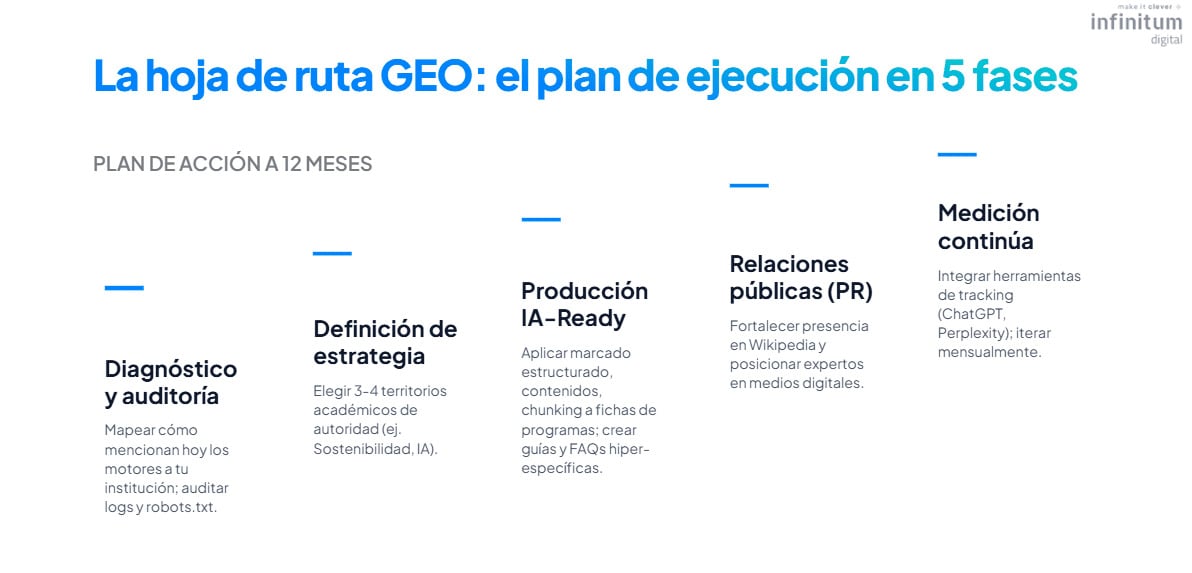 We combine expertise in technical SEO, content architecture, structured data and digital public relations to build the presence that generative engines need to consider you a reliable, citable and priority source in your category.