The BMAD method: Governed, scalable, and measurable agentic development
How to move from a chaotic prototype to an AI-driven software factory

Artificial intelligence promises to transform software development, but between promises and reality there remains a considerable gap. Tools such as ChatGPT, Claude, or Copilot have democratized code generation, but they have also given rise to a phenomenon as seductive as it is dangerous: vibe coding. The result? Prototypes that impress in a demo, but collapse in production.
In this article, we break down the BMAD methodology (Breakthrough Method for Agile AI-Driven Development), an orchestration framework for specialized agents that makes it possible to move from chaotic prototyping to a true AI Factory: a governed, scalable, and measurable software production chain. We do this based on real experience feedback from our teams who are already implementing it in migration, build, and run projects.
Vibe coding vs. agentic development: each to its own role
Before diving into BMAD, it is important to distinguish two AI-assisted development approaches that currently coexist and are often confused.
Vibe coding is the acceleration of development through natural language. A Product Owner describes their need directly to the LLM, which generates functional code without intermediary user stories or technical documentation. It is creative, fast, and intuitive. The problem is that it is also unreliable, difficult to maintain, and potentially dangerous in complex systems. It is ideal for prototypes, but not for structured projects.
Agentic development, on the other hand, turns AI into a full team of agents that intervene at every phase of the project: conception, architecture, technical planning, development, documentation, and testing. The goal of the AI Factory is to frame these new methodologies within a precise context and scale them.
The fundamental difference lies in control. In vibe coding, the degree of control is close to zero. In agentic development, each phase of the software lifecycle is governed by an agent with a defined role, scope, and toolset.
The base architecture of an AI Factory
To understand BMAD, one must first understand the fundamental building blocks of an AI Factory. The architecture is structured around three conceptual layers:
Tools are the basic actions: file reading, command execution, database access, unit test execution, report generation, or interaction with Git. They are functions or external services that an agent can invoke to act.
MCP (Model Context Protocol) is the interoperability and governance layer. It is the protocol that allows a model or agent to securely and structurally access external data, tools, or services such as GitHub, Atlassian, or internal databases.
Skills are business or technical competencies that group tools and domain logic. A skill might be, for example, a feature scoping assistant, a report generator, or a sprint planner.
This layered separation makes it possible to build specialized agents. A front-end developer and a back-end developer, for example, share certain tools (Git, command execution, file search) but have differentiated skills and tools: the front-end accesses Figma and the Design System, while the back-end manages the database and API tests.
Multi-agent systems: when agents work as a team
The true power of the AI Factory emerges when agents are chained together into workflows. A typical example would be a team of agents where a Manager coordinates, a Back-End Dev implements business logic, a Front-End Dev builds the interface, a Git Manager handles versioning, a Doc Writer generates documentation, and a Deployment agent automates delivery.
The key principles of this orchestration are four. First, define a clear role and scope of action for each agent in order to specialize and improve its output. Second, assign relevant tools and MCP access to each agent. Third, break down complex tasks into a sequence of small tasks to improve quality and efficiency. And fourth, use models adapted to the roles and tasks.
The limits of AI: context is everything
AI does not replace architectural thinking or strategic decision-making. Code produced by an LLM can introduce security flaws, dead code, useless dependencies, and obsolete patterns. It is necessary to control code quality and provide the LLM with clear context, precise directives, and continuous oversight.
This is where an emerging discipline comes into play: Context Engineering. It is not about writing long prompts in every session, but about building a persistent infrastructure that optimizes the agent’s environment. This infrastructure is organized into three memory tiers.
Tier 1, or the Constitution, is a permanent document, always loaded, containing the company’s baseline rules: naming conventions, build commands, architectural patterns, and routing tables to specialized agents.
Tier 2, or Specialized Agents, groups domain experts invoked on demand, containing facts about the codebase, specific patterns, and known failure modes to perform quality control.
Tier 3, or the Knowledge Base, gathers detailed specification documents retrieved on demand when a specific task requires them.
Context is managed as a true software component through a lifecycle. It is generated, tested as code using Test-Driven Development, versioned, and regularly purged of contradictions. An obsolete or contradictory context is the primary cause of agent failure.
This implies a new working rhythm. Time allocation is inverted: planning takes 40% of the time, execution 10%, evaluation 40%, and capitalization the remaining 10%. The developer is no longer the one who writes code, but the one who orchestrates, validates, and documents.
BMAD: the anatomy of the framework
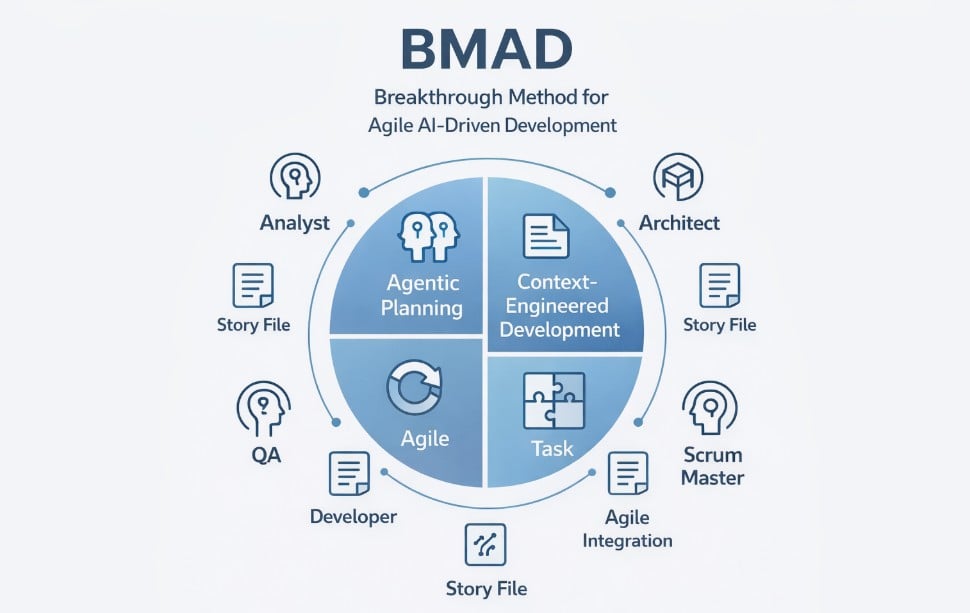
BMAD provides a structured response to all of these challenges. It is a specialized-agent orchestration method that includes more than 12 predefined agents, over 34 structured workflows, durable artifacts versioned in the repository, and multi-LLM compatibility with Claude Code, Cursor, Windsurf, and GitHub Copilot. It can be adapted from a simple bug fix to a full enterprise system.
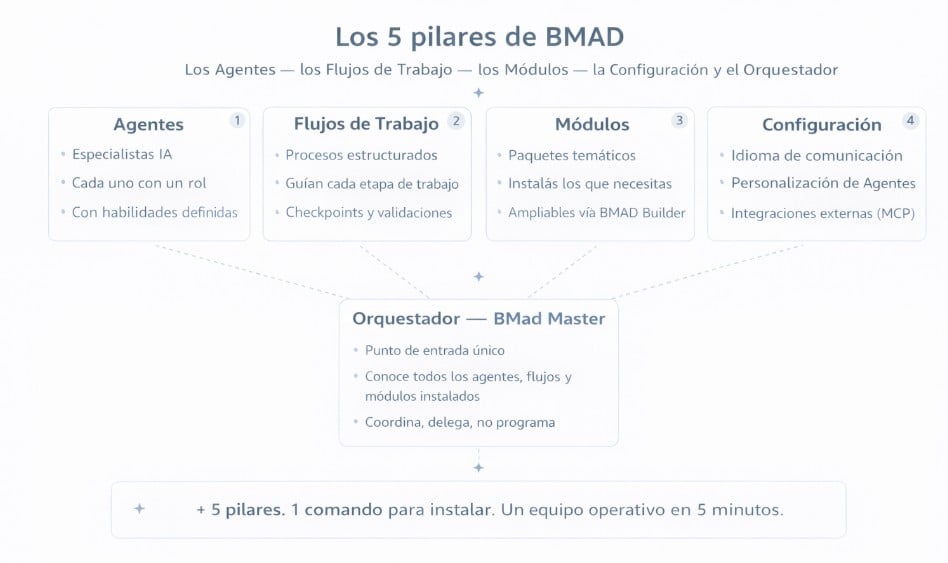
The 5 pillars of BMAD
- Agents: a virtual team. Each project role is a specialized AI agent. The Analyst (Mary) is responsible for market research. The Product Manager defines what is built. The Architect decides how to build it. The Developer writes the code and performs reviews. The Scrum Master organizes the work into stories. The UX Designer designs the interface. And QA tests quality. Five minutes to assemble a team. Zero onboarding.
- Workflows: phased workflows. BMAD structures development into chained phases ranging from brainstorming and product definition to architecture, technical planning, implementation, and deployment. Each phase produces specific artifacts: Product Brief, PRD (Product Requirements Document), architecture documents, epics, and user stories.
- Modules: compose your stack. These are coherent packages that group agents and workflows by domain. The principle is to install only what is necessary. Each module is installed via npm with a single command, and the core is included by default. The command is:
npx bmad-method install(requires Node.js v20+). In addition, in V6 the official modules have been consolidated: the core is BMM (BMad Method Master) and the extension factory is BMB (BMad Builder). Other relevant modules include TEA (Test Architect) for risk-based testing, BMGD (Game Dev Studio), and CIS (Creative Intelligence Suite). - Configuration: everything is adaptable. Global configuration allows defining the language, the user’s competency level, and the output directory for artifacts. External integrations include MCP connections with Atlassian, GitHub, and databases. Each agent can be customized individually, and overrides survive framework updates. Zero code to configure: configuration is based on Markdown and YAML files readable by anyone, without writing code.
BMad-Help: the guide and assistant. It acts as a distributed contextual guide rather than a central orchestrator. BMad-Help inspects the project state and recommends the next step.
Robustness and industrialization: scaling without losing control
Organizational change
BMAD changes team organization at two levels. At the company level, reusable elements must be integrated into the framework: technical stack, design system, predefined workflows, to maintain coherence across all projects. At the product team level, organization revolves around four key profiles: PO, Architect, Lead Dev, and QA, who orchestrate the project and intervene at the appropriate moments in BMAD workflows.
Multi-repository management
For complex projects involving multiple repositories, BMAD recommends an Orchestrator pattern: a central repository that coordinates shared documentation while each component maintains its specific artifacts. This avoids documentation duplication, clarifies ownership of each artifact, enables autonomous teams per component, and maintains a coherent global view.
Functional and technical robustness
Framework speed does not compromise solidity. The MVP is clearly defined, user stories include acceptance criteria, code reviews are systematic, and technical debt is integrated into the backlog. The target technical architecture is defined from the start of the project, and automated tests cover both unit and integration testing.
Delivery industrialization
The ultimate goal is to move from a one-shot project to a reproducible, reliable, and measurable model. This includes synchronization with the Atlassian suite via MCP protocols, an evolving roadmap, structured release management, shared KPIs, CI/CD, integrated GitHub management, versioned deployment, and rollback plans.
Conclusion: accelerating without losing understanding
BMAD combines the speed of agile with a reinforced governance framework. It enables rapid delivery of a useful, exploitable MVP, early alignment of IT and business, control of technical and budgetary risks, and preparation for industrialization from the first iterations.
Its strengths are clear: robustness, full control of all project phases, orchestration and information sharing between team and company, incremental approach, clear documentation, and an intelligent system for fragmenting large documents and processing them efficiently. Its weaknesses are also clear: a heavier initial process and high token consumption, although optimizable.
Where to start tomorrow?
Three concrete actions to get started today. First, create a 50-line constitution file detailing the team’s main conventions, patterns, and commands. Second, transform every explanation repeated twice to an agent into a permanent specification. And third, spend 10 minutes after each session documenting a lesson learned in the codebase.
The BMAD methodology, combined with a solid context engineering strategy, is today the most direct path from vibe coding to industrial agentic development. It is not about replacing developers, but about turning every team member into a context architect capable of piloting a true AI factory.
Further reading
- BMAD-METHOD – Breakthrough Method for Agile AI-Driven Development (GitHub)
https://github.com/bmad-code-org/BMAD-METHOD - Welcome to the BMad Method – Official Documentation
https://docs.bmad-method.org/ - BMAD Method – Introduction to Agentic Development (Video)
https://www.youtube.com/watch?v=LorEJPrALcg
The next step is not technical. It is strategic.
The question is no longer whether AI will transform software development. The question is whether your organization will architect that transformation or simply observe it.
If, while reading this article, you recognized familiar patterns (fast prototypes that do not scale, loss of control over code, difficulty industrializing AI usage without compromising quality and governance) it is no coincidence. These are the same challenges we see daily in organizations that want to move faster without breaking their system.
At Infinitum Digital in Spain and globally within the Clever Age group, we support technical and business teams along this path, from context definition to production deployment of an operational AI Factory. If this challenge concerns you or feels familiar, let’s talk. Sometimes, the right conversation at the right time makes the difference between experimenting with AI and turning it into a true competitive advantage.