
With the arrival and development of artificial intelligence, internet search and SEO are changing rapidly.
For universities and the education sector, it will be essential to understand these new trends and know how to adapt to them. Those who do so will have a significant advantage in online student recruitment.
Moving from SEO to GEO
Generative AI platforms provide very direct and tailored answers to received questions, reducing the need for end-users to visit websites. This means that in addition to traditional SEO, we now have to consider GEO (Generative Engine Optimization).
If we continue to measure only SEO results and website visits, we may think that we are reaching far fewer people. However, in reality, it is possible that we are reaching the same audience, with the difference that many of the reached users have seen us on ChatGPT, without the need to enter the website.
This phenomenon would be known as “search without clicks and, according to Gartner, could decrease organic traffic by 50% by 2028.
New metrics to measure reach
It is no longer enough to optimize our results in search engines, we have to consider how artificial intelligence interprets our content so that it can share it and help us reach more users, even if they are not reflected in organic traffic. We explain this in more detail in our article on AI-first approach.
To start improving this type of traffic and adopting the AI-first approach, we must ask ourselves:
- Does my institution appear in the answers generated by AI?
- What information do these platforms extract from my website?
- How can I optimize my content for AI to select it?
How can we measure AI-generated traffic?
Just as we did with SEO tools (Google Analytics, Semrush, etc.), we must now try to measure to what extent users get answers from our website without directly interacting with it.
Therefore, we must begin to consider a series of keys to monitor traffic with AI:
- Analysis tools: Companies have recognized the need to analyze this type of traffic, and therefore, tools are emerging to measure it. We explain the example of Otterly.AI below.
- Sentiment analysis: We must ensure that we appear in AI results, of course, but even more important is how. Sentiment analysis would be key to understanding the image of our institution conveyed by AI.
- Continuous process: We will need to update the content over time, just like with traditional SEO.
Otterly.AI: tool to measure visibility generated with AI
Otterly.AI is one of the tools that has emerged to measure this new type of traffic and help institutions increase their reach through AI. In addition to monitoring visibility on these platforms, it allows analyzing mentions and links that appear.
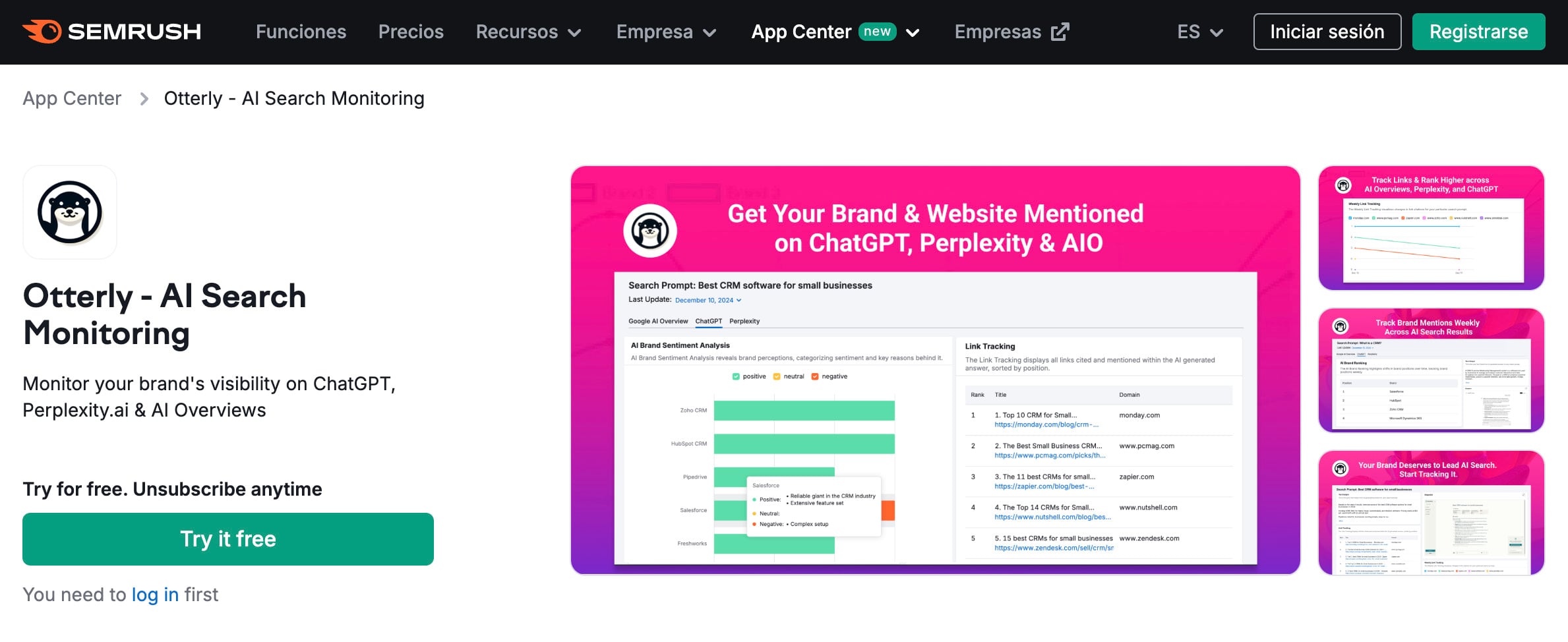
Furthermore, Otterly has partnered with Semrush, representing a connection point between SEO and GEO. Specifically, the AI application can be found in the Semrush App Center.
Preparing your educational institution for the AI-driven future
Adapting to AI can make the difference between institutions that fall behind and those that take a step forward, completely changing student recruitment dynamics. Giving importance to GEO and understanding how to measure it can be a great way to start.
At Infinitum Digital, we have extensive experience implementing projects for the education sector. If you want your institution to be up to date to maximize its results, contact us.
Infinitum Digital, digital experts in the education sector.