What you need to understand to redesign your ecommerce?
Is your online sales activity stagnating, failing to meet your expectations, or seemingly declining?

Your first instinct will undoubtedly be to take a critical look at your website(s), asking yourself the usual questions:
- Is the design outdated?
- Is the navigation too complex or unsuitable?
- Are essential features missing?
From then on, it is very tempting to want to redo everything, to start from scratch on a new and shiny new basis by changing solutions. But before you get started, it is a good idea to challenge this initial diagnosis to validate that the answer to the problem is a redesign.
Don’t rely on “feelings,” but base your approach on facts. A comprehensive study of your ecosystem could reveal other weaknesses that need to be addressed if you want to see real improvement.
The evolution of ecommerce and its impact
With the evolution of ecommerce, the website itself has become the visible part of a complex ecosystem.
Overall, commercial activity is based on digital business models whose foundations rest on three main pillars:
- The value proposition
This is your offering (product, services, or both), which defines the purpose of your business, the problem you solve for your customers, and why they should buy from you rather than elsewhere. The “What for Whom”. - The value architecture
The means and resources you implement within your company to deliver the value proposition and through which distribution channels. The “How”. - The profit equation
Your source of profitability, which combines revenue and costs/capital employed. The “How much”.
Over the last 30-35 years, this equation has seen an evolution in ecommerce that has led companies to explore, test, and sustain new value propositions through new models and value chains. This evolution is a succession of technological breakthroughs and adaptations of business models. It is not linear and is directly correlated to the complexity of business models and consumer expectations.
Each new stage in ecommerce requires more robust, integrated, and intelligent platforms to support new ways of selling and interacting with customers. In this sense, the evolution from monolithic to composable, from store to ecommerce platform, is a direct response to the complexity of online commerce.
It has moved from a simple “all-in-one” model to a modular and flexible architecture capable of adapting to the increasingly sophisticated needs of businesses and the ever-higher expectations of consumers.
A vast ecosystem
In this sense, in modern ecommerce, the website has become the visible part of a complex and multifaceted machine.
Where monolithic solutions used to include catalog management, customer management, order management, and search engines, omnichannel retailing has revolutionized the approach to sales. This revolution has been greatly accelerated by the COVID pandemic.
The product offering has become “plural” because it must respond to the specificities of different channels and business models. As a result, ecommerce platforms have become interconnected technological systems relying on specialized software components in key areas such as:
- Products (physical or services): What you sell
PIM/MDM enable you to manage product ranges and content according to channels (web, stores, mobile, etc.) and business models (B2C, B2B). - Customers: Who you sell to
CRM/CDP/RCU enable you to manage customer data from a 360° perspective across different sales channels and business models. The goal is to get to know your customers better in order to improve marketing effectiveness. - Offers: How you sell them
ERP and logistics components, on the other hand, ensure an optimal shopping experience for customers regardless of the channel.
The online shopping experience is becoming less and less like a simple digital storefront. It is a complex and finely tuned process in which every element, from logistics to customer relations to the alignment of your offering with your business model, must work in perfect synergy:
- The diversity of business models: Some companies and large groups are now positioning themselves on several models at the same time, such as B2C/D2C and B2B, developing affiliations, franchises, etc.
- The diversity of sales channels: It is becoming interesting to look beyond your online store and explore marketplaces, as a seller or operator, invest in social selling on social networks, integrate your store network, and offer mobile applications for related products or services.
- Product offering and pricing: The diversity of business models and channels requires significant work on the product offering: Defining the right fit between products and target customers, defining optimal inventory management between stockouts and overstocking and implementing a competitive pricing strategy while remaining profitable.
- Supply chain and logistics: Ecommerce and omnichannel retailing have permanently transformed the supply chain and logistics to meet specific needs around: Fast delivery and clear tracking, efficient returns and transparent communication.
- The omnichannel customer experience: Today’s customers are no longer satisfied with a single point of contact with retailers. They navigate between all the points of contact available to them. It is therefore crucial that they have a smooth and consistent experience with your offering, regardless of their point of entry.
- Internal organization: Economic profitability, beyond integrated tools, also depends on the teams involved at different levels of this complex ecosystem. Good communication between IT, Logistics, Marketing, Sales, Product Managers, Purchasing, Production, etc. is essential to avoid bottlenecks that are detrimental to overall business.
Audit to act better
In fact, on a sluggish site, there can be two strategies:
Before undertaking a redesign, conduct a comprehensive audit of your entire business to determine whether it is really your ecommerce storefront that is causing problems or whether there are several different causes at different levels.
The audit aims to define and analyze KPIs on the various pillars mentioned in the previous paragraph. The list is representative but not necessarily exhaustive depending on your business. It is an audit strategy task to be carried out together at the outset and put into perspective, for example, with a multi-brand organization and/or an international approach.
Some KPIS examples:
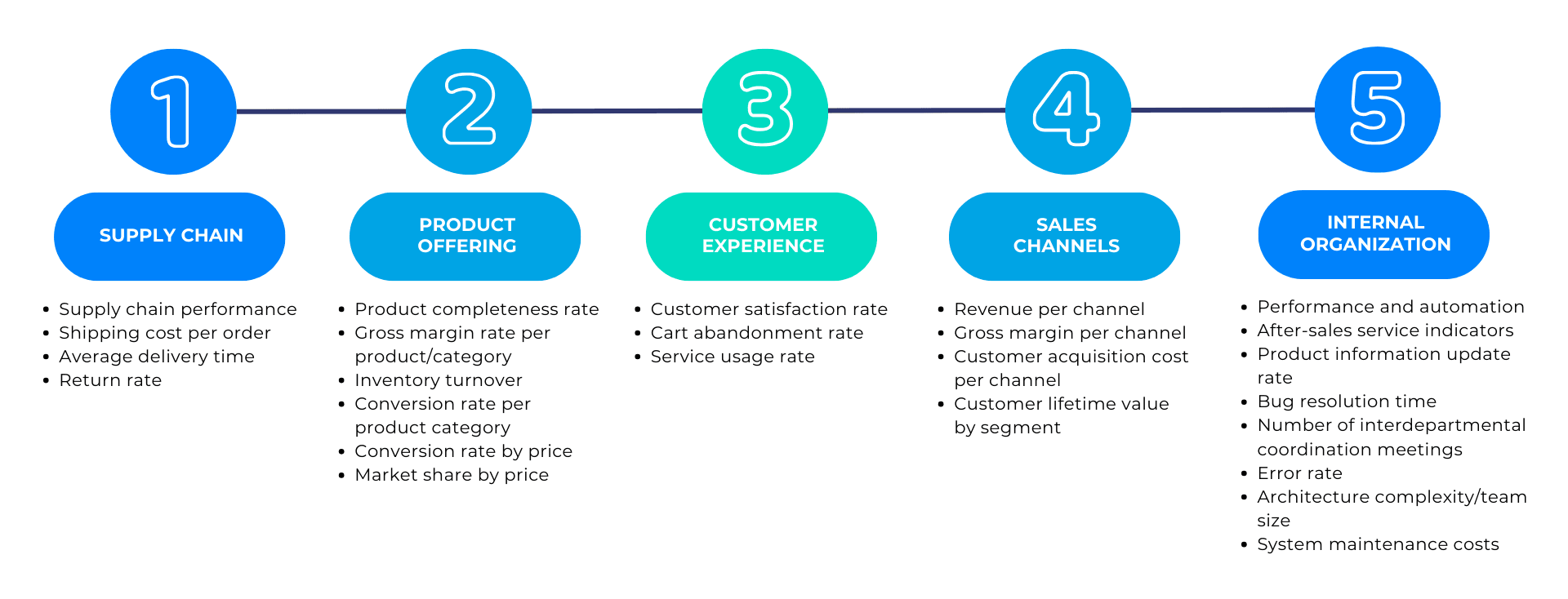
By analyzing these metrics, you may discover that the problem is not solely due to your website, but rather to inefficient logistics, excessive acquisition costs on a specific channel, an offering that is poorly sized in relation to the target audience or the competition, cannibalization between your different channels, weak automation leading to recurring human error that degrades the customer experience, etc.
In fact, the audit will give you a realistic view rather than a subjective impression. Its purpose is to guide you through the work that needs to be done and, above all, to define a consistent approach to dealing with each symptom. Yes, a redesign may be necessary, but an audit will allow you to validate this factually.
Infinitum Digital is here to support you!
As you know, in the world of omnichannel ecommerce, every detail matters. To turn your challenges into opportunities, we bring the experience of our senior teams to your service.
Our expertise is not limited to a single aspect: we offer you a complete and thorough analysis of your digital ecosystem.
Our experts, together with Clever Age, with years of experience in the digital field, are ready to analyze the core of your business in depth and evaluate every aspect, from the front-end of your ecommerce site to the most complex challenges in your supply chain and organization.
After an audit tailored to your needs, we will provide clear and personalized recommendations, developed by our teams to boost your performance and help you achieve your goals.
Contact us today to schedule your audit and give new life to your ecommerce business!