AI is also revolutionizing search engines in the tourism market
Towards a new era of conversational and visual search

Years ago, Janus Boye, from Boye & Company, already pointed out that traditional navigation on websites was losing its meaning compared to internal search and personalization. Now, with advances in artificial intelligence, that vision has been accentuated even more.
Specifically, AI is taking search engines to a new level, allowing for faster, more intuitive, and personalized results.
With these advances, it seems to make less and less sense for users to navigate the web trying to find what they want, instead of simply asking AI for it.
The Landfolk Case: When Internal Search Becomes a Competitive Advantage
A clear example of how an internal search engine can make a difference is found in Landfolk, a vacation rental marketplace that has opted for a radically different approach.
In addition to traditional search based on complex filters, Landfolk has developed a visual and intuitive internal search engine called Daisy, which completely transforms the user experience.
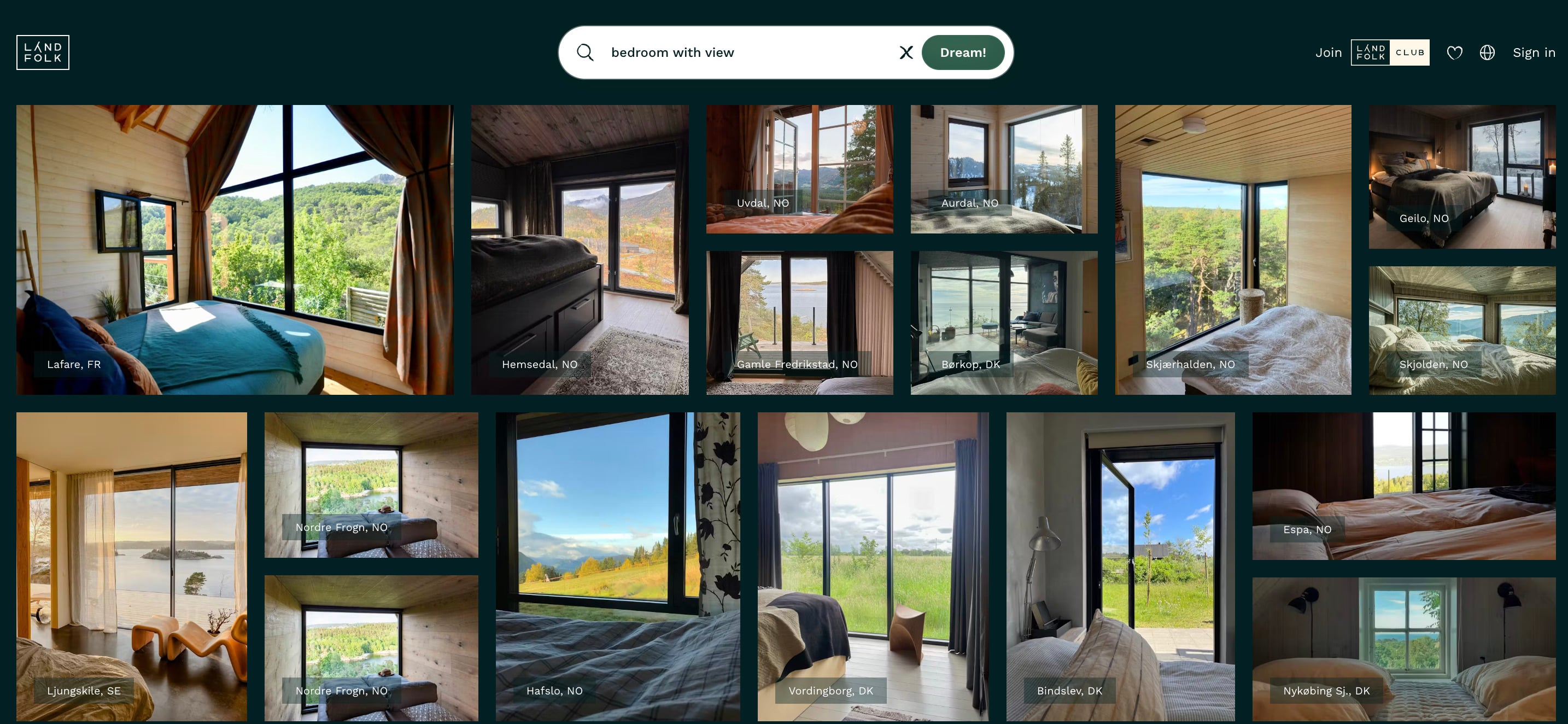
What makes the Daisy search engine from Landfolk special?
Imagine you want to find a vacation home with spectacular views. In most internal search engines, you would have to navigate through location filters, accommodation type, and view category, selecting multiple options manually.
In Daisy, simply typing "room with mountain views", and in a matter of seconds the search engine displays results based on a series of striking images that are fully related to the request.
This system reduces user effort and maximizes result relevance, offering a quick, smooth, and visually appealing search that increases user satisfaction.
The Results of this Change
- Better user experience: reduction of frustration from using complex search systems and increased loyalty.
- More interaction: users spend more time exploring options due to the fluidity of the process.
- Increased conversion: increase in booking rates thanks to a more intuitive and effective search.
Conversational Websites: The Future of Digital Experience
AI-powered search engines are not only transforming how users search for information, but are also laying the groundwork for a future where traditional websites will give way to conversational experiences.
It will be increasingly less necessary to navigate manually through content categorization models or perform traditional searches, as AI is capable of understanding what we want and offering great solutions instantly.
For this to be possible, it is essential that the content is well-structured within the information architecture. The better organized it is, the more effective its indexing and semantic search will be through natural language processing (NLP) techniques.
This will allow offering results based on the meaning and relevance of the content, instead of relying solely on keyword matches.
The conversational approach is becoming the standard in multiple sectors, and in tourism, where users seek personalized and fast experiences, it will be key for differentiation.
How to Optimize Internal Search on a Tourism Platform
To fully leverage the internal search revolution, tourism platforms must implement a strategy focused on personalization, speed, and artificial intelligence. Some essential keys include:
- Embracing conversational search: Incorporating AI tools that allow for searches with natural language.
- Enhancing visual search: Integrating high-quality images and an intuitive presentation of results.
- Optimizing speed and accuracy: A slow search engine or one with irrelevant results is a reason for immediate abandonment.
- Personalizing the experience: Using user behavior data to offer personalized recommendations.
- Continuously measuring and improving: Analyzing internal search data to constantly optimize the experience.
Both to offer personalized experiences and to analyze data, the best option may be to implement a CDP.
Search as a key factor in differentiation
Having an internal search engine is not enough: it must be optimized and turned into a differential value. Tourism platforms that bet on an advanced, intuitive, and personalized search experience will have a key competitive advantage in the sector. .
At Infinitum Digital, we have extensive experience helping companies in the tourism sector. If you want to improve your digital experiences, contact us.
Infinitum Digital, digital experts in the tourism market.